
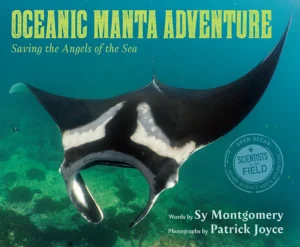
Sy Montgomery, Patrick Joyce (Photographer)
Clarion Books (10/06/2026) 9781328987297
— Lulu Miller, co-host of the WNYC program Radiolab
Junior Library Guild Gold Standard selection for elementary and middle grade categories

Join veteran science writer Montgomery in a highly enjoyable journey into the sea to explore and study all that is beautiful about manta rays. A map at the beginning of the book establishes the story’s setting in Puerto Lopez, Ecuador, where Montgomery and photographer Joyce scuba dive to study the “enormous and enigmatic” manta ray. Narrative chapters follow researchers as they explore manta rays, their environment, and the other creatures in their habitat. Important primary facts about manta rays are incorporated throughout, as well as commentary on the limitations and challenges of collecting data about ocean animals.
Joyce’s photos are captivating shots of manta rays from different angles, aerial views of the research boat, and close-ups of the scientists’ equipment. Details, images, and Montgomery’s enthusiastic tone create an immersive reading experience; readers will feel like one of the scientific team members, cheering and diving alongside researchers.
Montgomery even explores the Puerto Lopez community members who champion mantas; a moving passage about a local advocate who died in a car crash reminds readers that while scientists are hoping to solve mysteries with their data, sometimes “it’s a blessing enough to stand washed in wonderment before mystery itself.” VERDICT: This fascinating peek into an underwater research expedition may turn sea creature fanatics into aspiring marine biologists. A great addition to any nonfiction collection.
– School Library Journal
In another fantastic addition to the Scientists in the Field series, noted wildlife chronicler Montgomery dives (often literally) into her latest subject, the oceanic manta ray, with enthusiasm and awe. Traveling to Puerto López, Ecuador, with a team of scientists studying these enormous and mysterious marine denizens, Montgomery and photographer Joyce document their research and share facts about these creatures, which are facing extinction.
Montgomery captures the excitement of seeing the manta rays and the chaos of choppy winter seas, as well as challenges facing the scientists, including the theft of research materials, illness, and diminishing sightings due to climate changes and commercial fishing. Particularly moving is the story of diver Antonella Galindo, whose untimely death greatly affected the research community. Galindo’s family joins the team on a memorial dive with her beloved manta rays, illustrating the healing power of nature.
Montgomery’s text draws the reader into the project, capturing the participants’ reverence for all marine life and the significance of teamwork and community in protecting vulnerable species.
Joyce’s photographs illustrate all aspects of the work, but what stands out most are the images of divers alongside the massive manta rays, both creatures observing each other and wondering what the other perceives below the surface. Inspired readers can use the included bibliography and appended resources to engage in supporting the cause.
— Casey O’Leary, Booklist, Starred Review.
Montgomery’s latest entry in the Scientists in the Field series takes readers to Isla de la Plata, off the coast of Ecuador, where the surrounding waters contain the world’s largest population of giant manta rays. The book opens with a helpful map showing the geographic area and continues with a stirring description of the underwater setting. Here—clutching rocks to avoid being swept away by the swift current and peering through murky waters—Montgomery spies a manta. Awestruck, she describes the size and grace of the animal that peers back at her; Joyce’s dramatic photographs (with additional photos by Ecuadorian scientist Michael Guerrero) capture this incident and subsequent ones, allowing readers to see the ethereal scenes described in Montgomery’s immediate, engrossing text. The outlook for these majestic animals is dire: mantas are caught for food, tangled in fishing nets, and the victims of illegal harvesting of their gill plates. To help them, humans must know more about them; increasing that knowledge is the purpose of this expedition. Six researchers and photographers identify the mantas, tag them, take tissue samples, and place acoustic receivers underwater to track their movements. Montgomery explains both the what and the why of each process. That work is variously thrilling, tedious, and disappointing, but always life changing.
— Horn Book, Starred Review