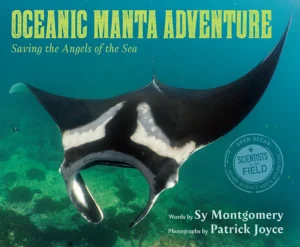
Sy Montgomery, Patrick Joyce (Photographer)
Clarion Books (10/06/2026) 9781328987297
Read an Excerpt:
Forty-five feet (14 m) below the ocean’s surface, we clutch at underwater rocks to avoid being swept away. The force of the Humboldt Current—the swift, cold, nutrient-rich underwater stream that flows north from Antarctica along the west coast of South America—is blasting us like a fire hose. Inches from our scuba masks, purple-and-orange striped starfish cling to the rock with thousands of suction-cupped tube feet. The faces of blennies, small fish with big eyes, pop from holes, gape at us, then dive back down. Bright fishes flash by—streaks of yellow, blue, orange, red, and black—and then disappear into a cloudy haze.
We can see only a few yards around us. Our vision is obscured by a blizzard of miniature algae and tiny animals: shrimplike krill, shorter than pencil erasers; see-through baby jellyfish; Jell-O-like salps; and creatures smaller than motes of dust. These are the floating plankton that nourish everyone from half-inch anchovies to forty-ton humpback whales. We are literally immersed in a sea of life. The conditions that make scuba diving here so challenging—the cold, the murk, the current—are what draw to these waters some of the most extraordinary creatures on the planet.
Even in our neoprene hoods, gloves, and seven-millimeter-thick wet suits, we are starting to get cold. Yet still, we wait. I look for one of the scientists to signal us. But even though they are only a dozen yards away, I can’t see them through the plankton soup.
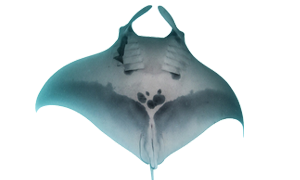
And then, above me and to my left, somehow I feel it before I see it. From the edge of my vision, in the liquid fog, a dark shadow gathers itself into the flattened shape of a giant flying carpet. It’s bigger than our boat is wide. It weighs thousands of pounds. As it approaches, it looks like an alien spacecraft about to make a landing. With impossible grace, it seems to fly toward us in slow motion on triangular wings spanning maybe fifteen, maybe eighteen, maybe twenty feet. We gaze up at a white belly, flecked with dark spots and scored with the gill slits of a fish. A long, whiplike tail trails behind. The creature turns and disappears back into the watery mist.
But a moment later, the animal circles back. It flies in closer this time—close enough for me to observe that the strange paddle-like fins at the front of the head are furled, like a towel you twist to wring dry; close enough to spot two large, dark remoras—hitchhiker fish—attached by their suckers to the creature’s bright belly; close enough to see the two long, tubular structures near the tail called claspers, marking him as a male. And then something even more extraordinary happens. As he passes overhead I see, at the base of his head fins, his big, dark eyes. I can see the eye closest to me swivel in its socket and lock on to my face.
Contact—with an oceanic manta ray: one of the largest, most mysterious, and most endangered creatures in the ocean. Once you meet one, the scientists who know them say that your life will never be the same.